
How a MERN Stack Certification Fits into Your Full Stack Developer Journey
Updated: Oct 8

Most learners chase a MERN stack certification first and build projects later. That order is backwards.
A certificate is a milestone, not proof you can do the job. Employers want to see code, projects, and clear thinking.
In 2025 MERN Stack development framework used by around 45% developers.
MERN combines MongoDB, Express.js, React, and Node.js. Together, they let you build a full web app using only JavaScript.
This guide maps the journey: fundamentals, MERN skills, projects, certification, portfolio, interviews, and your first role.
What Does a MERN Stack Certification Offer
A certification shows you completed structured training in the MERN ecosystem.
It confirms you passed assessments or built projects.
But it does not prove job readiness.
Employers still judge your code, your projects, and how you solve problems.
The Four Technologies Behind MERN
MERN Stack stands for MongoDB, Express.js, React, and Node.
MongoDB: stores data as flexible documents.
Express.js: builds the backend and APIs.
React: creates the user interface.
Node.js: runs JavaScript on the server.
Each tool handles one layer.

Your job is to make them work together.
A login feature shows how.
React renders the form.
Express handles the route.
Node.js checks the credentials. MongoDB stores the user.
What a Good Program Should Cover
Use this checklist before you enrol:
JavaScript and ES6 fundamentals
React with hooks and routing
Node.js and Express
MongoDB and data modelling
REST APIs and authentication
Git and GitHub
Deployment
Testing and debugging basics
Real projects
A certificate backed by projects and assessments carries more weight than a simple completion letter.
It shows structured learning and commitment.
Your portfolio shows skill. You need both. Be honest about the limits too.
Certification will not replace experience.
Side Note: A MERN stack certification can demonstrate structured learning, but your projects, coding ability, GitHub portfolio, and ability to solve real development problems are what strengthen your job profile.
Where Does Certification Fit in the Full Stack Developer Journey?
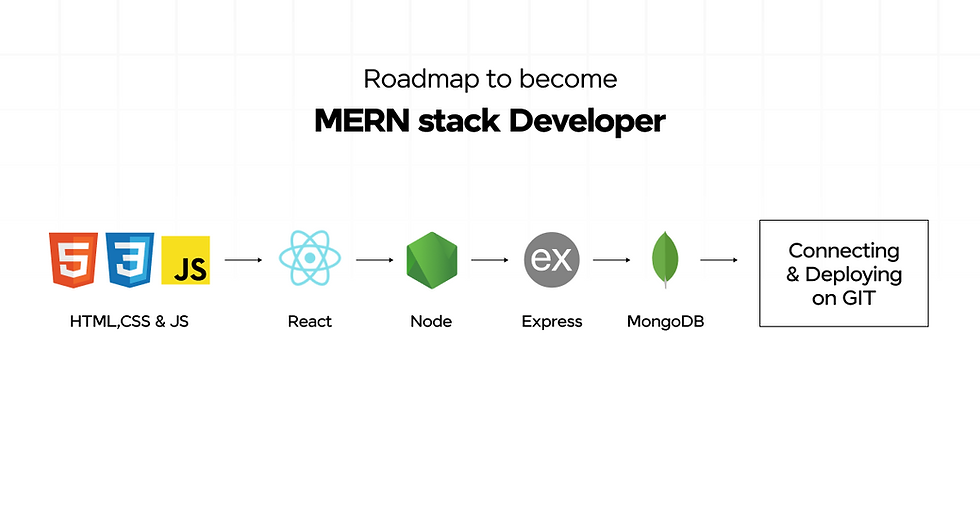
Certification fits after you build skills and projects. It sits in the middle of the journey, not at the start. Here is the path, step by step.
With 35% yearly growth, MERN stack jobs are in high demand. What you need are the right skills through the right program.
Step 1: Build Your Web Foundations
Start with HTML, CSS, and JavaScript. Learn ES6 features, responsive design, and basic programming logic.
Skipping this step creates gaps. Learners who jump straight into React often struggle to debug simple errors.
Step 2: Learn Frontend Development with React
Learn components, props, state, and hooks. Then move to forms, routing, and API calls. Build interfaces that work on phones and laptops.
Step 3: Move Into Backend Development
Use Node.js and Express to build REST APIs.
Add server-side logic, authentication, authorization, and error handling. Test every route with Postman.
Step 4: Learn Database Management with MongoDB
Understand collections and documents. Practise CRUD operations.
Learn data modelling. Connect MongoDB to Node.js with Mongoose.
Secure your database with basic access rules.
Step 5: Connect Frontend, Backend, and Database
This is where you start thinking like a full stack developer. Follow one request through the system:
React → API call → Express/Node.js → MongoDB → response → React
Draw this flow for every project.
Each arrow is a place where bugs hide.
Check the network tab, the server logs, and the database one by one.
Step 6: Build Real Projects
Go beyond basic CRUD. Pick projects that solve a real problem:
E-commerce app
Job portal
Learning management platform
Appointment booking system
Admin dashboard
Document the problem solved, the tools used, and the features built. Add a GitHub repository and a live deployment link.
Scale the difficulty.
Start with a CRUD app and a responsive interface.
Move to authentication and user roles.
Finish with a portfolio-level project that has an API, a database, login, deployment, and clear documentation.
Once the basics feel solid, add an AI feature.
Try smart search, a chatbot, or a RAG-based Q&A tool. Treat AI as an extension, not a shortcut.
Step 7: Earn Your MERN Stack Certification
Now the certificate makes sense. You already have skills and projects.
The certification becomes proof of structured learning, not a paper collected without practice.
Skills You Need Beyond MERN
Git and GitHub: branches, pull requests, and a visible portfolio.
Debugging: read error messages, use browser developer tools, and check backend logs.
Deployment: take a local app and put it online.
Communication: explain technical choices and take part in code reviews.
AI-assisted development: use AI to explain code, debug, and write documentation. Always review what it produces.
How to Choose a Training Program Become Employable
Choose a program that teaches by building.
Then convert your learning into a portfolio and interview skills. Both steps matter.
Check the Program Before You Enrol
If you search for the best training institute in Kolkata, compare programs on substance, not slogans.
Ask these questions:
Does the curriculum cover the full checklist above?
How many projects will you build from scratch?
Can you deploy them and show them to employers?
Do mentors review your code?
Does the certification include practical assessment?
Recorded lessons alone rarely build confidence.
Live feedback and code reviews do.
What Placement Support Should Include
Do not accept the phrase at face value. Ask whether it includes:
Resume preparation
Mock interviews
Interview guidance
Application support and job opportunities
Career counselling
The best training institute in Kolkata will explain these services clearly.
It will not guarantee jobs.
Build a Job-Ready Portfolio
GitHub: regular commits, clear README files, screenshots, and clean code structure.
Portfolio site: an about section, skills, projects, live links, and contact details.
Prepare for interviews in JavaScript, React, Node.js, Express, MongoDB, REST APIs, and Git.
Expect project questions too.
Be ready to explain what you built, why you chose that approach, what went wrong, and how you fixed it.
Which Roles Can You Target?
Role | Primary Focus |
Frontend Developer | React and user interfaces |
Backend Developer | Node.js, Express, and APIs |
MERN Stack Develope | Frontend, backend, and database |
Full Stack Developer | End-to-end applications |
JavaScript Developer | JavaScript-based applications |
Titles vary by company. Compare your skills with each job description.
Common Mistakes to Avoid
Collecting certificates without building anything.
Copying tutorials line by line without understanding them.
Ignoring Git until the final week.
Never deploying a project.
Skipping JavaScript fundamentals.
Each mistake costs you interview time. Fix them early.
What to Do After You Earn the Certificate
First 30 days: polish your projects, clean up GitHub, build your portfolio, and revise JavaScript.
Next 60 days: practise interview questions, build one more project, and apply for relevant roles.
Then keep learning.
Study modern React practices, backend architecture, cloud deployment, performance, security, and AI integration.
A MERN stack certification marks a milestone.
Continuous practice builds the career.
Learn the fundamentals, build real projects, earn the certificate, and prove your skills through a portfolio.
Start with the basics. Build something every week.
Looking for the best training institute in Kolkata to start your MERN journey? Check out Desun Academy’s MERN Stack program and get on a counselling call to understand what’s actually taught!
FAQs
1. Is a MERN stack certification enough to get a developer job?
Not on its own. It works best combined with real projects, a strong GitHub portfolio, and interview preparation.
2. Do I need a computer science degree to learn MERN stack development?
No. Many non-engineering graduates learn MERN stack development successfully through structured, project-based training.
3. How long does it take to become job-ready with MERN stack skills?
This varies by learner, but most structured courses combined with consistent practice take several months to build genuine job readiness.
4. What roles can I apply for after MERN stack training?
Common entry points include MERN Stack Developer, Full Stack Developer, Frontend Developer, Backend Developer, and JavaScript Developer roles.


Comments